+1 5618168645
pexels-photo-11116578-2.webp)

From Basics to a Full Collection: How to Design a Baby Bedding Series
A baby bedding collection rarely becomes successful because of one exceptionally designed product. More often, it works because several products feel as though they belong together.
A crib sheet may be attractive on its own, but when the same fabric language, color story, pattern scale, and functional thinking extend into blankets, swaddles, sleeping bags, and nursery accessories, the product begins to feel like part of a collection rather than an isolated item.
For brands developing baby bedding, the real design challenge is therefore not simply creating more products. It is creating relationships between products.
Start With One Strong Foundation Product
A collection does not need to begin with ten SKUs.
In many cases, one well-defined core product is enough to establish the direction. A fitted crib sheet is a practical starting point because it immediately raises several design questions:
- What fabric should define the collection?
- What colors represent the brand?
- Should the pattern be subtle or expressive?
- Does the product feel modern, natural, playful, or premium?
Once these decisions are clear, the rest of the collection can grow from them.
The mistake is to treat every new product as a completely separate design project. That often produces a catalog full of individually attractive items that do not work together. Instead, the first product should establish the visual and functional vocabulary for everything that follows.
Build Around a Design Language, Not a Single Pattern
A common approach to collection design is to repeat the same print across every product. It is easy to manage, but it can quickly make a collection look repetitive.
A stronger approach is to create a shared design language. For example, a collection might use:
- One primary color family
- One or two supporting colors
- A consistent fabric texture
- Related botanical or animal motifs
- Different pattern scales for different products
- The same finishing details across selected pieces
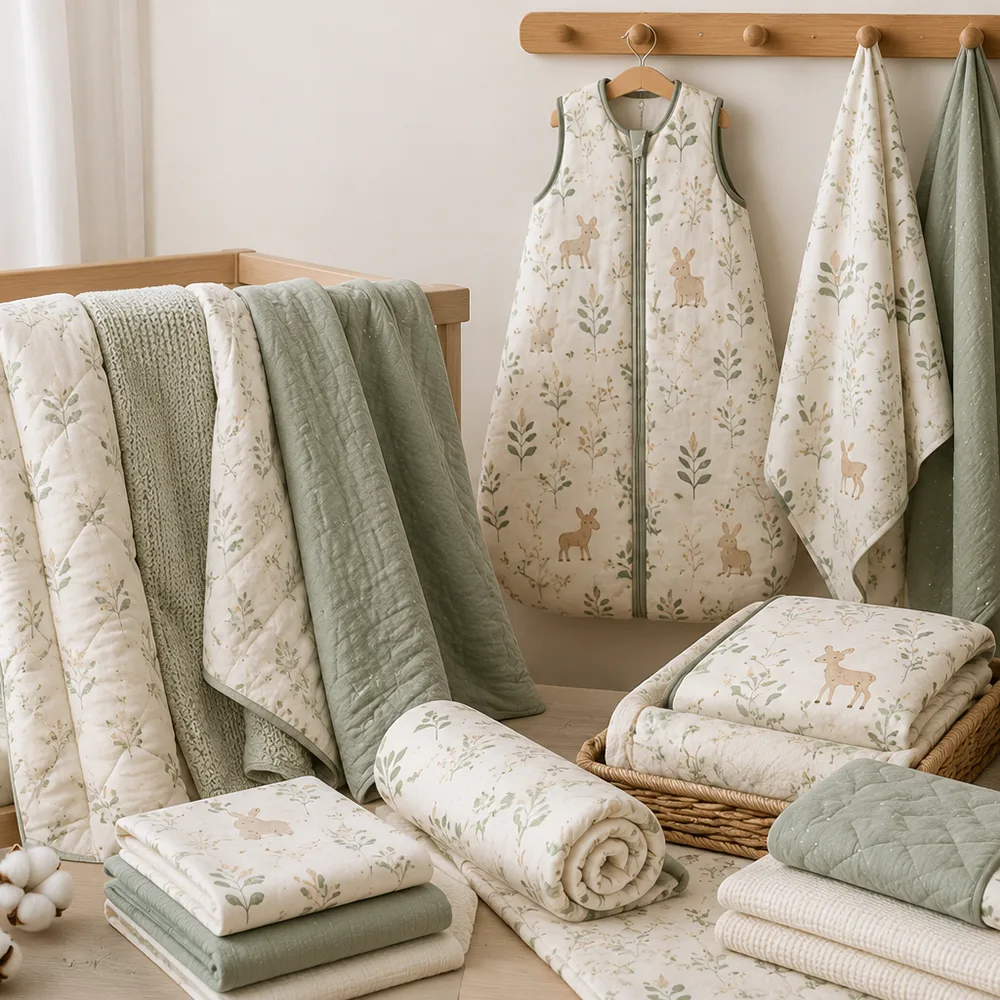
The crib sheet might carry the main pattern, while a swaddle uses a smaller version of the motif. A blanket could use a solid coordinating color with a textured finish. A sleeping bag might combine the two.
The products are different, but the relationship between them is immediately recognizable. This is particularly useful for retailers because it creates opportunities to merchandise products together without making every item look identical.

Related motifs and scaled patterns create visual harmony without monotony.
Think in Layers of Function
A good baby bedding collection should also have a functional structure, with each product designed around comfort, practicality, and safe sleep recommendations. One useful way to plan it is to divide products into three layers:
Core layer — Everyday essentials such as fitted sheets and basic blankets.
Comfort layer — Products designed around different stages or routines, including swaddles and sleeping bags.
Supporting layer — Smaller nursery textiles or accessories that complete the visual story.
This structure prevents a collection from becoming a random assortment of products. It also gives buyers more flexibility. A retailer may start with a small selection of core products and gradually add complementary pieces as demand becomes clearer.
Let Fabric Connect the Collection
Fabric is often the most overlooked tool for creating product continuity.
A collection does not necessarily need to use exactly the same material everywhere. In fact, that may limit functionality. Instead, materials can be selected according to the role of each product while maintaining a consistent tactile direction.
For example:
- Breathable cotton for everyday sheets
- A softer knitted construction for a lightweight blanket
- Another fabric more appropriate for a seasonal sleeping bag
What connects these products is not identical material composition, but a consistent philosophy around softness, weight, breathability, care, and intended use.
This approach also gives product developers more room to adapt a collection to different climates and markets without losing its identity. At the same time, material and construction decisions should always reflect the intended use of each product. For infant sleep products, designers can also refer to established safe sleep guidelines when considering products such as swaddles and wearable blankets.
Use Color to Create a System
Color becomes much more powerful when it is treated as a system rather than a decoration. Instead of choosing ten unrelated colors, consider building a hierarchy:
- Core colors establish the identity of the collection.
- Secondary colors provide variation without breaking consistency.
- Accent colors create visual interest and can be used selectively on prints, trims, labels, or smaller accessories.
This system makes future product development easier. A new blanket or swaddle can be added months later without requiring an entirely new visual direction. It also creates a useful commercial advantage: buyers can combine products across different categories while maintaining a coordinated nursery look.
Design the Collection for Expansion
One of the best tests of a bedding collection is to imagine the next five products before producing them.
If the design concept only works for one crib sheet, it is probably too narrow. A stronger concept should naturally extend into different formats.
A simple woodland theme, for instance, can evolve into leaves, trees, small animals, textures, and neutral colors without relying on one repeated illustration. A minimal geometric concept can move between printed sheets, solid blankets, quilted products, and accessories through proportion and color rather than identical graphics.
This is where good collection design becomes more than styling. It creates a framework for future product development.
The Best Collections Leave Room for Variation
Consistency does not mean uniformity.
A successful baby bedding series should have enough repetition to feel connected, but enough variation to remain interesting. The practical goal is to establish a recognizable structure while leaving room for:
- Seasonal color updates
- New prints
- Different fabric weights
- Age-specific products
- Regional preferences
- Limited-edition designs
This is especially important for brands that expect their assortment to evolve. A collection designed as a system can absorb new ideas without constantly starting from zero.
From a Product to a Product Family
The shift from basic products to a collection is ultimately a shift in thinking.
Instead of asking, “What should the next product look like?”, product developers can ask, “What role should the next product play within the existing collection?”
That small change can influence everything from fabric selection and color planning to packaging and merchandising.
A crib sheet can establish the visual foundation. A swaddle can introduce another pattern scale. A blanket can add texture. A sleeping bag can extend the same design language into another stage of use.
The result is not simply a larger product catalog. It is a coherent baby bedding system—one in which each product has its own purpose while still making sense beside the others.
For brands, that kind of structure can make seasonal updates, new product development, and assortment planning considerably more manageable. And for buyers, it creates something equally valuable: a collection that looks designed as a whole rather than assembled one product at a time.
Key takeaway: Great baby bedding collections are built on relationships — between products, materials, colors, and functions — rather than on isolated designs.