+1 5618168645

Premium Cotton, Bamboo Viscose, or Muslin? A Manufacturer’s Guide to Sourcing the Right Crib Sheet Fabrics
For baby brands, importers, and private-label retailers, choosing the right crib sheet fabric is one of the most consequential sourcing decisions you will make. It determines product performance, compliance risk, and ultimately whether your shipment clears customs in the EU or North America. This guide compares three leading materials — premium cotton, bamboo viscose, and muslin (double-layer gauze) — across the dimensions that matter most at scale: touch, breathability, shrinkage control, and regulatory certification.
If your brand sources from China, understanding these trade-offs at the manufacturing level is essential. MK Kids works with global partners to support fabric selection and compliance alignment across baby and kids product development, as a China baby bedding manufacturer.
1. Premium cotton: the industry benchmark
High-quality combed cotton remains the most widely used material in mid-to-high-end crib sheet manufacturing, and for good reason. Its predictability across the supply chain makes it the safest starting point for most brands.
Touch and comfort
Combed cotton delivers a clean, classic softness that actually improves after the first few washes. Unlike regenerated fibers, it has a naturally “dry” handfeel, which many parents in warmer markets prefer for year-round bedding.
Breathability
Cotton’s natural fiber structure allows moderate, consistent airflow — suitable for year-round use across most climates. It does not excel at active moisture management the way bamboo does, but its thermal regulation is reliable and well understood.
Shrinkage and durability
Cotton’s biggest manufacturing advantage is dimensional predictability. With proper pre-shrinking and finishing processes, shrinkage can be controlled within industry-acceptable ranges across high-volume production runs. Lower-grade cotton or under-treated fabric, however, can still lead to dimensional instability after repeated laundering.
Compliance notes
Cotton fiber itself is broadly compliant in EU and North American markets. The compliance risk lies in chemical finishing agents, dyes, and bleaching processes — all of which must meet stringent safety thresholds under OEKO-TEX Standard 100 and related frameworks.
2. Bamboo viscose: softness leader, processing-sensitive
Bamboo viscose has become a premium positioning staple in baby bedding, particularly for brands targeting the luxury or eco-conscious segment. Its silky texture commands higher retail prices — but it requires tighter process control at the factory level.
Touch and comfort
Bamboo viscose is exceptionally smooth, often described as “buttery” or silk-like. This tactile quality is its primary market differentiator and the main reason brands select it for premium collections.
Breathability and moisture management
The fiber structure of bamboo viscose provides excellent moisture absorption and release, making it ideal for hot or humid environments. For parents concerned about infant overheating, this is a meaningful functional benefit — not just a marketing claim.
Shrinkage and stability
This is where bamboo viscose demands more from manufacturers. Without controlled finishing, it may exhibit higher shrinkage rates and reduced structural stability after repeated laundering. Proper blending ratios or mechanical finishing processes are often required to bring performance in line with cotton standards.
Compliance notes
Bamboo viscose production involves chemical processing, which places greater emphasis on residual chemical control and certification documentation. Dyeing agents, softeners, and finishing chemicals must all fall within OEKO-TEX or GOTS-approved thresholds — a non-negotiable for EU and North American retail access.
3. Muslin (double gauze): maximum breathability, natural aesthetic
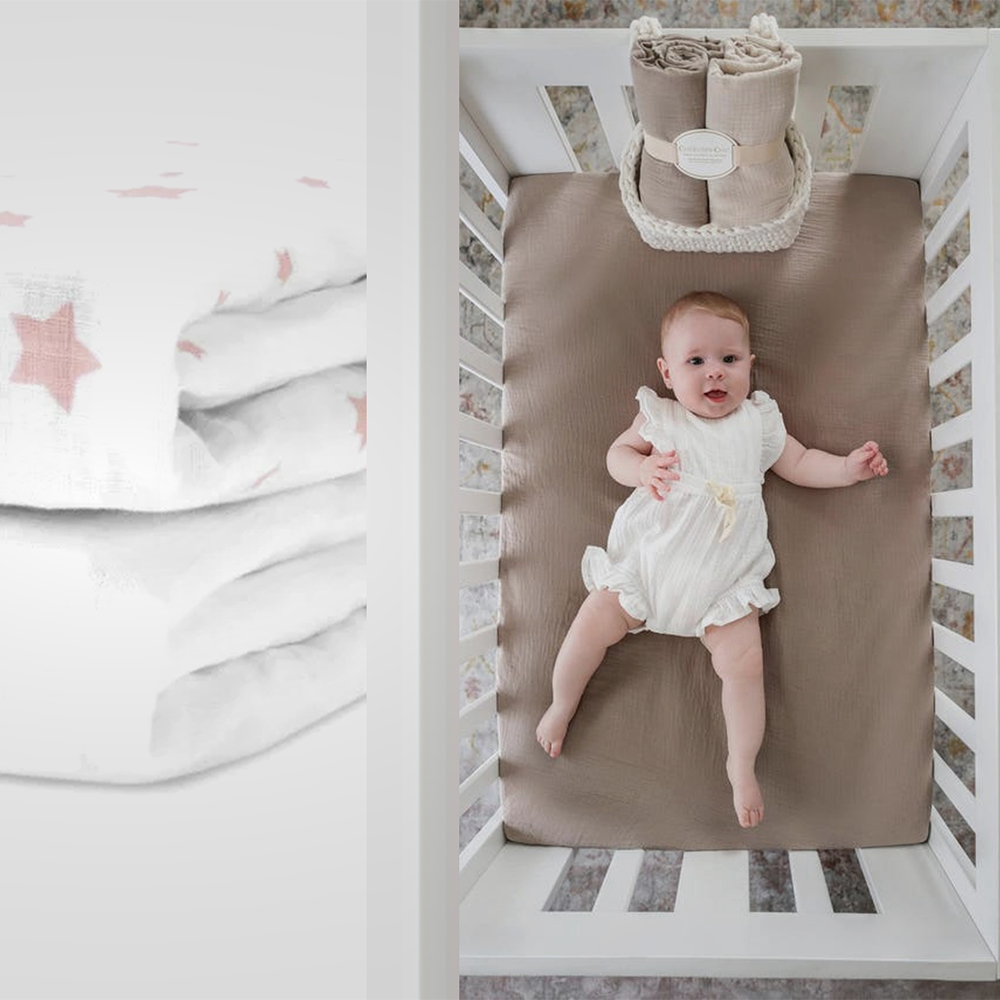
Muslin — typically constructed as double-layer gauze cotton — has become a signature material in modern baby textiles, strongly associated with organic and natural product lines.
Touch and comfort
Muslin offers a soft but distinctly textured handfeel. Its natural crinkled appearance is not a defect — it is a deliberate aesthetic that many parents associate with organic simplicity and craftsmanship. It softens further with each wash.
Breathability
Among all three materials, muslin is generally considered the most breathable. Its loose weave allows maximum airflow, making it especially suitable for summer collections, warmer climates, or brands explicitly targeting breathability as a core product benefit.
Shrinkage and behavior
Muslin typically shrinks more noticeably than tightly woven cotton unless it is pre-washed or pre-shrunk during production. Importantly, some degree of shrinkage is expected and contributes to muslin’s characteristic relaxed texture. Manufacturers must account for this in pattern cutting and sizing specifications.
Compliance notes
Because muslin is marketed as “natural” or “organic,” it faces heightened consumer and retail scrutiny. Any deviation in dyeing or finishing quality can directly undermine its premium brand positioning, making certification documentation especially critical for this material.
4. Side-by-side comparison
| Dimension | Premium cotton | Bamboo viscose | Muslin (double gauze) |
|---|---|---|---|
| Touch | Clean, classic softness | Silky, ultra-smooth (“buttery”) | Soft with natural crinkled texture |
| Breathability | Balanced, year-round | Moisture-regulating, cooling | Maximum airflow, ideal for warm climates |
| Shrinkage control | High stability | Sensitive — needs tight process control | Higher tendency — pre-wash recommended |
| Process complexity | Standard finishing | Controlled blending or mechanical finishing required | Pre-shrinking at pattern stage required |
| Compliance risk | Lower | Higher (chemical processing) | Medium (organic claim scrutiny) |
| Best for | Everyday essentials, broad market | Premium / luxury positioning | Organic, natural, aesthetic-driven lines |
5. Why certification is now a compliance gateway
International retailers and customs authorities increasingly require proof that textiles meet recognized safety and environmental standards. For baby products specifically, two certifications define market access:
GOTS (Global Organic Textile Standard) ensures organic fiber content and environmentally responsible processing throughout the supply chain. It is required for any product sold as “organic” in major retail channels.
OEKO-TEX Standard 100 verifies that the finished textile has been tested for harmful substances and is safe for direct skin contact — a baseline requirement for many EU and US retailers, even for non-organic product lines.
Failing to meet these standards results in shipment delays, customs rejection, or retail delisting. The compliance risk is not theoretical — it is a routine operational reality for brands importing from Asia.
6. Supply chain capability: the real differentiator
Beyond fabric selection, the defining advantage for global baby brands is upstream supply chain control. Brands that integrate certification-compliant sourcing at the manufacturing stage dramatically reduce downstream regulatory friction — and shorten time-to-market for new collections.
As an established baby bedding manufacturer in China, MK Kids operates with an integrated sourcing system supporting premium cotton, bamboo viscose, and muslin — with access to certified-compliant materials aligned to GOTS and OEKO-TEX requirements. This upstream capability delivers three practical benefits for brand partners:
Regulatory risk reduction. Fabric sourcing is aligned with international safety and environmental standards before production begins — not corrected after a failed audit.
Batch-to-batch consistency. Stable sourcing reduces variation in softness, shrinkage, and dye performance across large production runs.
Faster market entry. Pre-certified material availability accelerates compliance documentation, reducing time-to-market for new collections.
7. Strategic recommendations by product positioning
Material selection should follow product strategy, not personal preference:
Choose premium cotton for reliable, everyday products that need balanced performance across a wide range of consumers and climates. It offers the best risk-adjusted profile for high-volume production.
Choose bamboo viscose for ultra-soft, cooling, premium collections where touch experience is a primary purchase driver. Budget for tighter process controls and robust certification documentation.
Choose muslin for breathable, organic, or natural-aesthetic-driven baby lines where the material’s visual character is itself a brand signal. Ensure pre-shrinking is integrated into the production specification.
Regardless of material choice, compliance readiness is the single factor that most determines whether a product successfully reaches shelf in global retail markets. Brands that address this at the sourcing stage — rather than the logistics stage — operate with a structural advantage. For brands looking to learn more about factory-level compliance support, our China baby bedding wholesale manufacturing page covers the full scope of what we offer.
Frequently asked questions
Which crib sheet fabric is safest for newborns?
All three materials — cotton, bamboo viscose, and muslin — can be safe for newborns when sourced from certified suppliers and processed without harmful chemicals. OEKO-TEX Standard 100 certification is the most reliable indicator of finished-product safety for direct skin contact.
Is bamboo viscose truly eco-friendly?
Bamboo is a fast-growing plant, but viscose production involves chemical processing. GOTS certification is the most credible way to validate that the full supply chain — fiber, processing, and finishing — meets environmental standards.
How much does muslin shrink after washing?
Untreated muslin can shrink 5–8% after the first wash. Manufacturers typically account for this through pre-shrinking treatments or by building additional seam allowances into pattern specifications. Pre-washed muslin products will shrink minimally in subsequent washes.
What certifications do I need to export baby textiles to the EU?
OEKO-TEX Standard 100 is widely recognized by EU retailers and helps demonstrate compliance with REACH chemical safety regulations. GOTS is additionally required for products sold with organic claims. Specific retailer requirements vary — always confirm documentation requirements with your buyer before production begins.