+1 5618168645


Why Are Medical Scrubs Becoming More Stretchy? The Ergonomic Science Behind Spandex
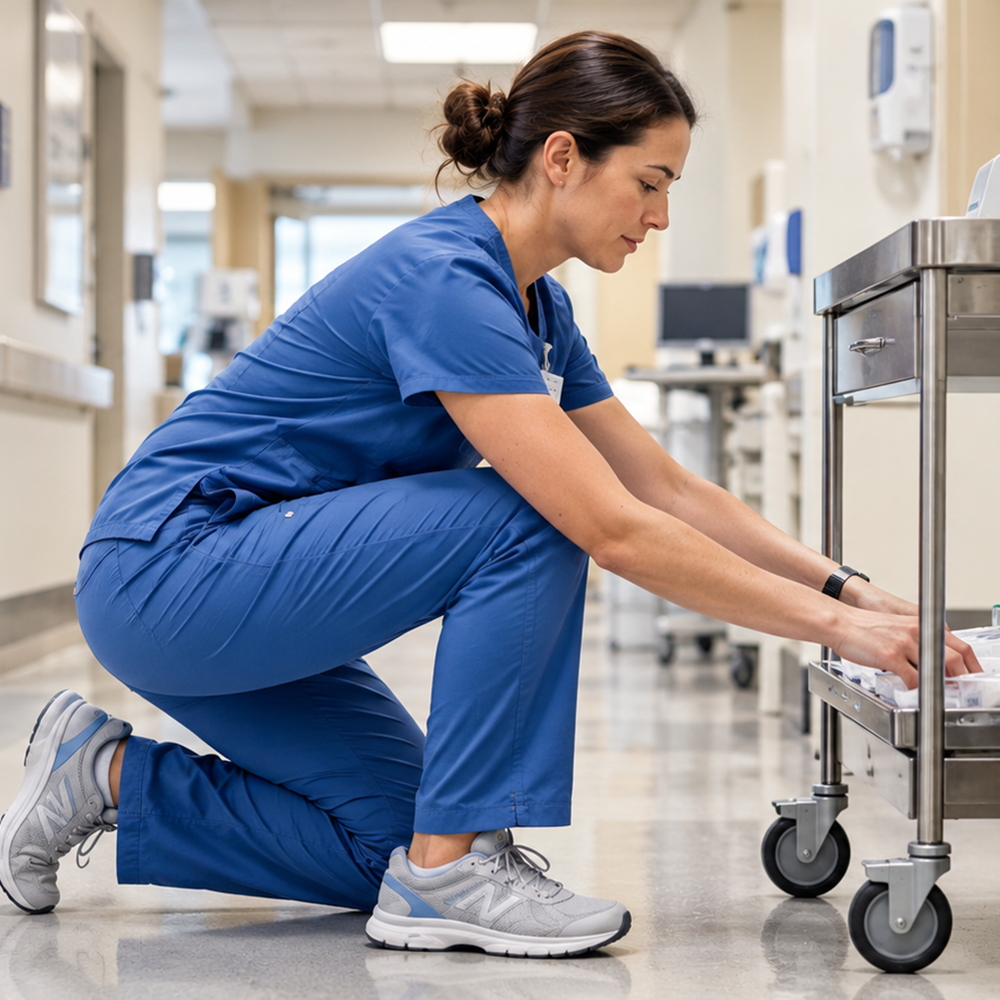
Why are modern medical scrubs increasingly designed with stretch? The answer has less to do with fashion trends and more to do with how healthcare professionals actually move throughout a working day. Bending, reaching, squatting, lifting, walking, pushing equipment, and repeatedly moving the arms are all common parts of clinical work.
For this reason, fabric flexibility has become an important consideration when developing medical uniforms. Spandex, also known as elastane, is often added in small percentages to help fabric accommodate repeated body movement without making the garment excessively loose or heavy. In this article, we look at the ergonomic reasons behind stretch scrubs and explain how Spandex contributes to mobility, comfort, and garment recovery.
1. Why Ergonomics Matters in Medical Scrubs
Ergonomics is essentially the study of how products and environments interact with the human body. In workwear, this means considering how clothing behaves while the wearer performs real tasks rather than evaluating a garment only when standing still.
Medical professionals may spend many hours walking between rooms, leaning over patients, reaching across beds, sitting, standing, or working with their arms raised. A uniform that fits comfortably in a static position may therefore feel restrictive during repeated movement.
This is where fabric stretch becomes relevant.
A garment with appropriate elasticity can temporarily expand as the body moves and then return toward its original dimensions. Instead of relying entirely on a loose silhouette to provide movement space, the fabric itself can accommodate changes in body position.
2. How Healthcare Workers Move During a Shift
Healthcare work involves a surprisingly high frequency of relatively small movements. A nurse may reach forward to adjust equipment, bend down to assist a patient, squat to access supplies, or repeatedly extend the arms while performing clinical procedures.
These movements create tension in different areas of a garment:
- Shoulders and upper back: Arm elevation and forward reaching can pull fabric across the back and shoulder blades.
- Elbows and sleeves: Repeated bending requires additional fabric flexibility around the elbow.
- Waist and hips: Sitting, bending, and squatting change the distance between the torso and legs.
- Knees and thighs: Squatting and kneeling increase the amount of fabric extension required around the lower body.
If a fabric has limited elasticity, the garment pattern must compensate by adding extra ease. If there is too much ease, however, the uniform can become excessively loose or lose its clean appearance.
Stretch fabric provides another way to create movement capacity: controlled elasticity within the material itself.
3. What Does Spandex Actually Do?
Spandex is a highly elastic synthetic fiber, also commonly called elastane. It is commonly used in medical scrub fabrics to improve stretch and recovery, allowing the material to accommodate repeated body movement without compromising fit.
Even a relatively small amount of Spandex can change how a fabric responds to movement. When the wearer bends an elbow or stretches across a bed, the fabric can extend instead of immediately resisting the movement.
The practical effect can be summarized in three functions:
- Extension: The fabric can temporarily increase in dimension when the body moves.
- Recovery: After the movement, the material can return toward its original shape.
- Fit retention: Repeated movement does not necessarily require the garment to be cut excessively loose.
This makes Spandex particularly useful in garments where mobility and appearance need to coexist.
However, Spandex is only one part of the equation. The final performance also depends on the base fiber, yarn construction, knit or woven structure, fabric weight, garment pattern, and finishing process.
4. Stretch vs. Recovery: Two Different Properties
One common misunderstanding is that a fabric with more stretch is automatically better.
In reality, stretch and recovery are different properties.
Stretch describes how much a fabric can extend when force is applied. Recovery describes how effectively it returns toward its original dimensions after the force is removed.
For medical uniforms, recovery can be particularly important because garments are exposed to repeated movement throughout a shift. A fabric that stretches easily but recovers poorly may gradually become loose around the knees, elbows, seat, or waistband.
A balanced fabric therefore needs enough elasticity for movement while maintaining dimensional stability during repeated wear and washing.
| Property | What It Means | Why It Matters in Scrubs |
|---|---|---|
| Stretch | How far the fabric can extend | Allows greater freedom of movement |
| Recovery | How well fabric returns to its original shape | Helps maintain fit during repeated use |
| Fabric Weight | Mass of fabric per unit area | Influences drape, coverage, and wearing comfort |
5. Why More Stretch Is Not Always Better
Adding more Spandex does not automatically create a better medical uniform.
Excessive elasticity can change the hand feel, appearance, dimensional stability, and manufacturing characteristics of a fabric. Very stretchy materials may also require different sewing techniques and can make pattern control more challenging.
For medical apparel, the objective is generally functional stretch rather than maximum stretch.
The fabric needs to move when the wearer moves, but it should still provide sufficient structure for pockets, seams, waistbands, and other functional components.
The ideal balance depends on the garment design. Stretch trousers may prioritize hip, thigh, and knee mobility, while a scrub top may require greater flexibility around the shoulders, upper back, and sleeves.
This is why fabric composition should be considered together with garment construction rather than evaluated independently.
6. What Should Buyers Look for in Stretch Scrubs?
For apparel buyers and product developers, evaluating stretch scrubs involves more than checking whether a fabric contains Spandex.
Important questions include:
- What is the fiber composition? Cotton, polyester, nylon, rayon, and blended fabrics can create very different wearing characteristics even with similar Spandex content.
- Where is stretch needed? Identify high-movement areas such as shoulders, elbows, waist, hips, and knees.
- How well does the fabric recover? Repeated stretching and washing should not cause excessive deformation.
- How does the fabric behave after laundering? Medical uniforms are frequently washed, so dimensional stability and appearance retention matter.
- Does the fabric remain breathable? Mobility should not come at the expense of thermal comfort.
For product development, it can therefore be more useful to evaluate stretch, recovery, breathability, durability, fabric weight, and wash performance together rather than focusing on Spandex percentage alone.
7. Conclusion
The growing use of stretch fabrics in medical scrubs is closely connected to the realities of healthcare work. Medical professionals do not remain in one position for long periods; their clothing must accommodate frequent bending, reaching, walking, sitting, squatting, and arm movement.
Spandex helps provide this flexibility by allowing fabric to extend and recover as the body moves. But the ergonomic value of stretch does not come from Spandex alone. Fiber composition, fabric construction, garment pattern, weight, recovery, and laundering performance all contribute to the final result.
For medical apparel development, the goal is not simply to make scrubs more elastic. It is to create a balanced fabric-and-garment system that supports freedom of movement, fit stability, durability, and everyday comfort.